Why Is Medicai the Best for DICOMweb Integration?
Your radiology team spends hours each week moving DICOM studies between systems that still rely on legacy protocols. Many platforms force extra steps or manual fixes when connecting to modern web services.
By the end of this article you will see exactly how Medicai handles DICOMweb requests, what storage and viewing tools are included, and which pricing tier fits a clinic, hospital network, or research group.
What Is Medicai?
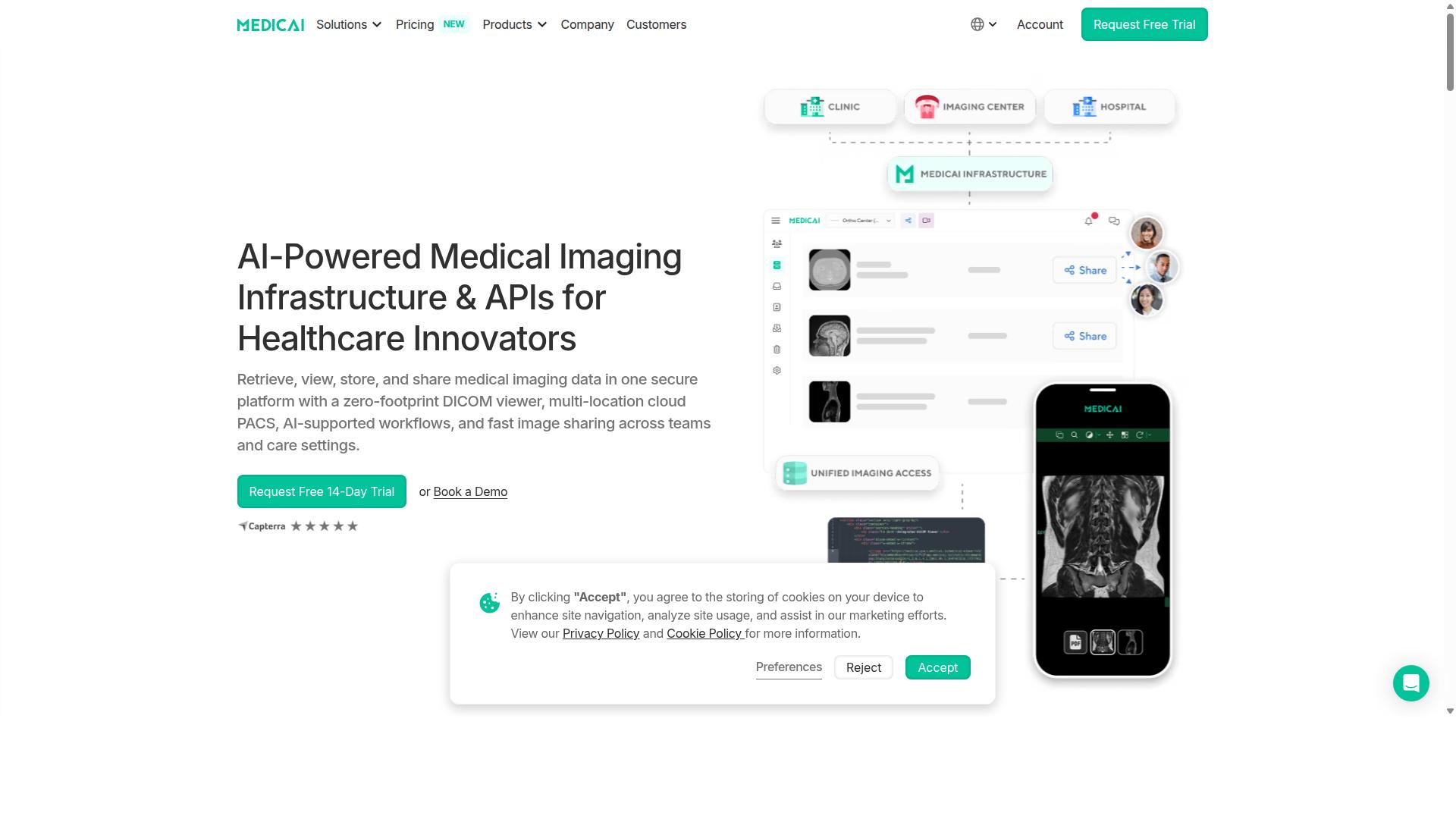
Medicai is a cloud-based medical imaging platform that enables healthcare providers to retrieve, view, store, and share medical imaging data in one secure platform with a zero-footprint DICOM viewer.
The platform operates as a SaaS solution with global online availability. This model allows medical facilities to access imaging services without installing local hardware or software systems.
Medicai provides Imaging Infrastructure as a Service for healthcare organizations of all sizes. A VC-backed healthcare startup, the company focuses on modernizing medical imaging workflows and enabling interoperability across different care settings.
Healthcare providers can use the platform for multi-location cloud PACS needs. The system supports fast image sharing across teams and care settings while maintaining security standards for sensitive medical data.
AI-supported workflows form another component of the platform. These workflows help healthcare professionals manage medical imaging processes more efficiently within their existing systems.
Why Medicai Excels at DICOMweb Integration
DICOMweb's three core RESTful services, WADO-RS, STOW-RS, QIDO-RS, form the backbone of modern medical image exchange. These services enable healthcare providers to retrieve, store, and query imaging data through standardized web protocols. Organizations seeking reliable interoperability benefit from platforms that implement these services consistently.
Medicai implements WADO-RS to allow secure image retrieval through HTTPS endpoints. Token-based authentication ensures only authorized users access patient records. Responses return in JSON or XML formats that integrate smoothly with existing radiology systems.
STOW-RS handles image storage operations within the same secure framework. Encrypted data exchange protects sensitive medical imaging during transmission. Systems can push DICOM objects to cloud storage while maintaining compliance with healthcare regulations.
QIDO-RS provides query capabilities that help locate specific studies across large archives. Metadata filtering allows users to search by patient ID, study date, or modality type. Results display quickly through structured response formats.
These three services work together to support complete medical imaging workflows. RESTful API design enables developers to build applications that communicate reliably with PACS systems. Healthcare facilities gain flexibility when connecting different vendors and platforms.
Security remains central to every interaction through DICOMweb services. Audit logs track access patterns while encryption protects data in transit. Organizations maintain compliance without sacrificing performance or accessibility.
Key Features and What Makes Medicai Stand Out
Three capability clusters, connect, store, and access, define how Medicai handles imaging data end-to-end.
These clusters create a complete system for handling medical images across healthcare environments. Each part works together to support reliable data movement and storage needs.
The approach focuses on practical interoperability that meets real clinical demands. Healthcare teams receive tools that handle daily imaging workflows without complexity.
CONNECT & RETRIEVE Capabilities
The Medical Imaging Uploader and DICOM Gateway allow facilities to ingest studies from any modality directly into the cloud.
These upload methods support multiple transfer syntaxes and work with various imaging equipment types. The system processes DICOMweb requests through WADO-RS, STOW-RS, and QIDO-RS endpoints.
RESTful API connections enable secure data exchange between different healthcare systems. Authentication protocols and encryption methods protect patient information during transfer.
STORE & MANAGE Infrastructure
Cloud PACS, Medical Image Exchange, Vendor Neutral Archive, and automated backup services give providers a single source of truth.
Multiple storage tiers accommodate different retention policies for various clinical needs. The Vendor Neutral Archive maintains data accessibility while supporting long-term storage requirements.
Backup and Disaster Recovery services protect against data loss. These features support compliance standards such as HIPAA while maintaining data availability for clinical operations.
ACCESS, VISUALIZE, COLLABORATE Tools
Real-time visualization and sharing tools, zero-footprint viewer, Patient Case Management, and AI integrations, accelerate multi-specialist workflows.
The DICOM Viewer and Doctor Imaging Portal provide secure access to medical images from different locations. These tools work with existing hospital systems through standard protocols.
FDA and CEE clearance confirm the platform meets regulatory standards for medical device software. These certifications support deployment in clinical environments that require validated solutions.
Pricing and Plans
Medicai offers transparent monthly subscriptions scaled to storage and connectivity needs. The platform aligns costs directly with DICOMweb integration requirements for healthcare organizations handling medical imaging data. This structure supports radiology workflows without unexpected billing variations.
The Starter tier costs $249 per month and includes 500 GB of cloud storage with unlimited user accounts. This plan supports organizations testing DICOMweb connectivity without multi-site requirements. No connected locations are included at this level.
The Standard tier costs $749 per month and provides 2 TB of cloud storage with unlimited user accounts plus one connected location. This configuration suits practices needing reliable DICOM image retrieval through WADO-RS endpoints and STOW-RS upload capabilities.
Organizations requiring multiple sites can upgrade to the Enterprise tier with custom pricing. This tier accommodates multiple connected locations and external connections for vendor neutral archive deployments across healthcare networks.
Yearly billing provides 15 percent savings compared to monthly rates. The Starter plan reduces to $209 per month and the Standard plan reduces to $639 per month when paid annually. Enterprise pricing remains custom regardless of billing frequency.
A $1,000 one-time setup fee applies per location for DICOM Gateway installation. This fee covers initial configuration for QIDO-RS query capabilities and secure data exchange protocols.
A free 14-day trial of Starter plan features is available without requiring a credit card. Per-study pricing options exist for enterprise customers managing variable imaging volumes. Refunds are not available for partial billing periods.
Trust Signals
HIPAA and GDPR compliance, FDA/CEE clearance, and SOC 2-level operational controls underpin Medicai's security posture.
Healthcare organizations require proven safeguards when handling medical imaging data. Medicai follows OWASP security guidelines to protect patient information throughout the integration process.
Microsoft Azure partnership adds enterprise-grade infrastructure protection. The combination of regulatory clearances and encryption standards creates a secure foundation for DICOMweb integration.
Who Should Use Medicai
Hospitals, imaging centers, and specialty clinics handling high volumes of cross-site image exchange are primary users. These organizations often face challenges moving medical images between different facilities and systems. They need reliable methods to share data without delays or errors.
Orthopedics teams use this platform when they must review scans from multiple locations before surgery. A surgeon can pull recent X-rays and MRIs from an external clinic into their local system to plan the procedure accurately.
Neurology departments benefit when patients transfer between hospitals. Doctors can access brain scans from another facility through a single interface, reducing the time needed to make urgent treatment decisions.
Oncology practices rely on consistent image access for tumor board meetings. Specialists from different locations can review the same CT or PET scans at the same time, improving coordination of care plans.
Radiology groups need fast image retrieval when covering multiple sites. A radiologist can view studies from remote clinics through standardized protocols, maintaining consistent reporting quality across locations.
Cardiology teams access echocardiograms and angiograms from partner facilities. This supports timely consultations when patients arrive with prior imaging from outside providers.
Ophthalmology clinics share retinal images and OCT scans for remote consultation. Referring doctors can send studies to specialists without requiring patients to carry physical media between offices.
OB-GYN practices use the system to review ultrasound studies from external imaging centers. Maternal-fetal medicine specialists can access detailed scans quickly when managing high-risk pregnancies across multiple sites.
Pulmonology departments integrate chest CT and X-ray images from various sources. This helps track disease progression in patients who receive care at different facilities over time.
Dentistry practices exchange cone-beam CT and panoramic radiographs with oral surgeons. This streamlines referrals when complex cases require collaboration between general dentists and specialists.
Gastroenterology teams review CT and MRI studies from outside radiology departments. This supports pre-procedure planning when patients arrive with imaging from other healthcare systems.
Final Verdict
For organizations seeking a secure, globally accessible, and standards-compliant medical imaging platform, Medicai delivers measurable value.
Healthcare providers need solutions that handle image retrieval, metadata exchange, and patient records without compromising security or scalability. Medicai addresses these requirements through a vendor neutral archive built on RESTful API standards that include WADO-RS, STOW-RS, and QIDO-RS.
The system supports interoperability with existing PACS infrastructure and enables data exchange across cloud storage environments. Token-based authentication, encryption protocols, and audit logs help maintain HIPAA compliance while supporting radiology workflows that demand both speed and accuracy.
Organizations considering Medicai for their medical imaging needs can contact the company directly for a live demonstration. Medicai USA operates at 7901 4th St N, STE 300, St. Petersburg, FL, 33702 with phone support at +1 (832) 220 1035. Medicai Romania is located at 53-55 N Filipescu, 5th Floor, Sector 2, Bucharest, 020961 and can be reached at +40 316 305 875. Email inquiries go to sales@medicai.org.