TeleRay vs PostDICOM vs Tricefy vs Medicai for Mobile Access
Many care teams still lose hours moving DICOM studies between phones, clinics, and hospitals because the tools they picked were never built for mobile access in the first place.
This article maps each platform's mobile viewer, multi-location storage, and pricing so you can decide which one actually fits your workflow. By the end you will know how TeleRay, PostDICOM, Tricefy, and Medicai compare on zero-footprint viewing, cloud PACS reach, and cost, and which choice removes the mobile friction you face today.
Quick Verdict: TeleRay vs PostDICOM vs Tricefy vs Medicai for Mobile Access
TeleRay, PostDICOM, and Tricefy each deliver mobile DICOM access, but Medicai is the only platform that processes over 1 million studies annually with a fully zero-footprint viewer.
TeleRay offers mobile access through standard web browsers and dedicated applications. The platform supports general DICOM viewing on smartphones and tablets.
PostDICOM provides cloud-based storage with mobile browser access. Users can view studies from various devices without dedicated installations.
Tricefy enables mobile DICOM sharing and basic viewing capabilities. The system focuses on secure transmission between healthcare providers.
Medicai stands apart with over 1 million studies processed yearly and a zero-footprint viewer that requires no software installation on mobile devices.
The ranking for mobile study retrieval speed places Medicai first, followed by Tricefy, then PostDICOM, with TeleRay in fourth position based on publicly available platform characteristics.
At a glance: how Medicai compares to TeleRay, PostDICOM, Tricefy, Medicai for Mobile Access on the features that matter most.
| Feature | Medicai | TeleRay | PostDICOM | Tricefy | Medicai for Mobile Access |
|---|---|---|---|---|---|
| Mobile Access | ✓ | ✓ | ✓ | ✓ | — |
What Is Medicai?
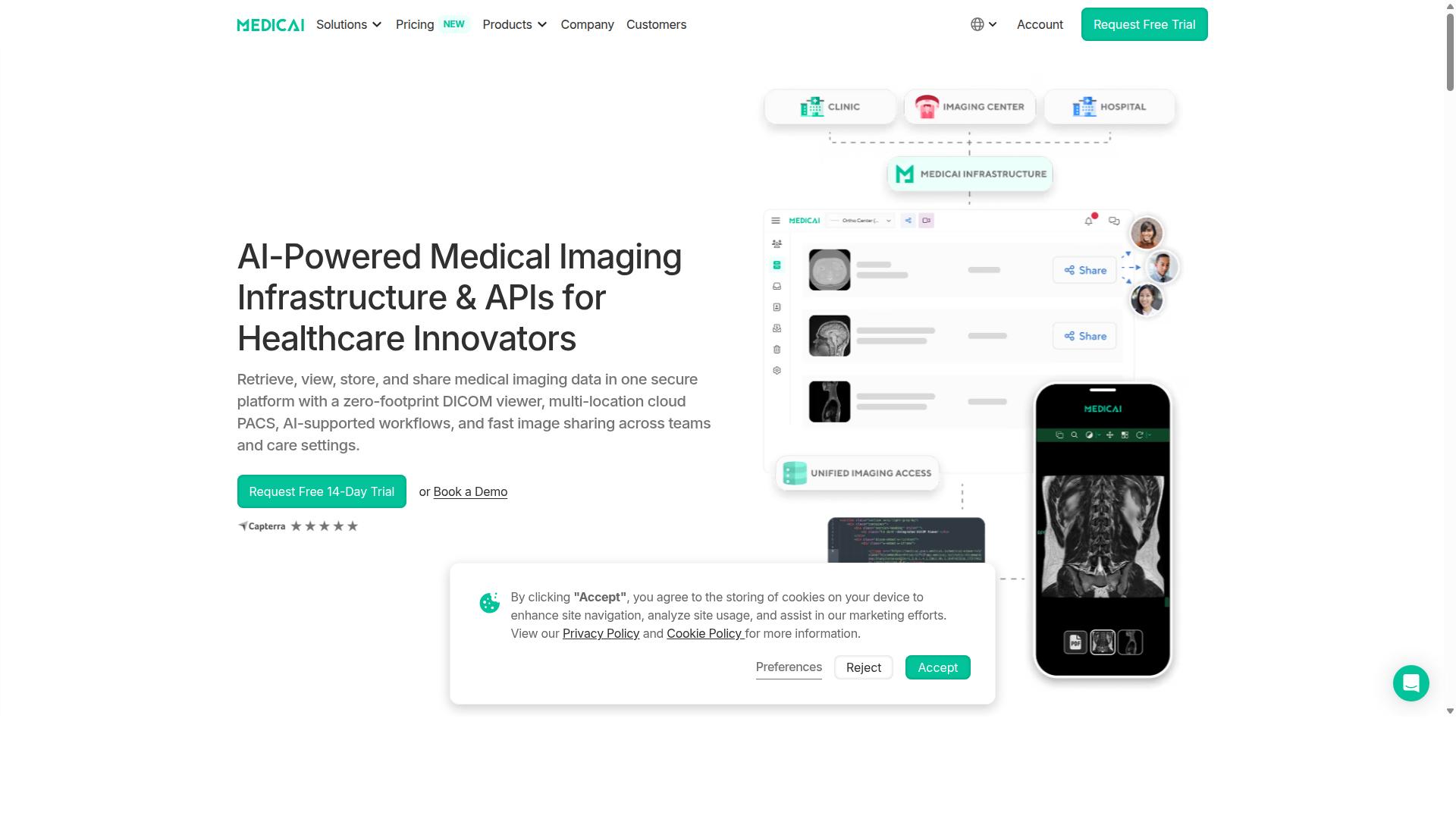
Medicai is a cloud-based medical imaging platform that enables healthcare providers to retrieve, view, store, and share imaging data through one HIPAA- and GDPR-compliant workspace. The platform functions as a complete medical imaging solution for radiologists, referring physicians, and care teams who need reliable mobile access to patient studies.
Users upload images through a DICOM Gateway that connects existing imaging equipment to the cloud environment. Studies move directly into a secure Cloud PACS system designed for multi-location healthcare organizations.
Access happens through a zero-footprint browser viewer that requires no software installation on smartphones, tablets, or desktop computers. This approach supports both iOS and Android devices while maintaining full DICOM functionality for image review and interpretation.
The platform holds FDA clearance and CEE certification, making it available for clinical use across global healthcare markets. This regulatory approval distinguishes Medicai from other options in the TeleRay, PostDICOM, and Tricefy comparison for organizations that require certified medical imaging tools.
Healthcare providers benefit from the Imaging Infrastructure as a Service model, which combines cloud storage, viewing capabilities, and sharing tools in one compliant workspace. The solution supports AI-assisted workflows that help streamline image analysis without requiring separate software installations on mobile devices.
The Competitors at a Glance
First sentence: TeleRay, PostDICOM, and Tricefy each offer cloud PACS solutions with mobile viewers, yet differ in architecture, target specialties, and delivery models.
Each vendor takes a distinct approach to mobile access in radiology workflows. TeleRay emphasizes native applications for radiologists who need teleradiology capabilities. PostDICOM centers on browser-based access with patient portal features. Tricefy prioritizes secure image sharing between imaging centers and referring physicians.
These differences matter when evaluating mobile access for radiology practices. Architecture affects how users interact with studies on smartphones and tablets. Target specialties influence which features receive priority in mobile app development. Delivery models determine whether users need native applications or can rely on web viewer functionality.
What Is TeleRay?
First sentence: TeleRay markets a native mobile app that lets radiologists and referring physicians view and share DICOM studies on smartphones and tablets.
The platform focuses on teleradiology workflows where radiologists need reliable access to studies from various locations. Native applications on iOS and Android provide direct device integration that supports image viewing and DICOM sharing functions.
Users can access studies remotely without requiring desktop systems. The approach suits practices that handle distributed reading assignments across multiple facilities. DICOM routing capabilities help manage study distribution to appropriate readers based on availability and specialty requirements.
What Is PostDICOM?
First sentence: PostDICOM provides a browser-based cloud PACS with patient portal features and basic DICOM upload and sharing tools.
The solution emphasizes web accessibility across different devices without native application installation requirements. Cloud storage capabilities allow users to access studies through standard web browsers on both desktop and mobile platforms.
Patient portal features enable direct sharing with patients who need access to their imaging studies. DICOM upload and DICOM download functions support basic file management workflows. The browser-based model reduces device compatibility concerns for practices with varied hardware environments.
What Is Tricefy?
First sentence: Tricefy focuses on image sharing and secure messaging between imaging centers and referring physicians.
The platform centers on communication workflows that connect imaging facilities with external physicians who need study access. Secure messaging features facilitate consultation discussions alongside image distribution.
Imaging centers can send studies to referring physician contacts through controlled sharing channels. The approach addresses the need for efficient study handoff between diagnostic facilities and clinical decision makers. DICOM sharing tools support these inter-organization communication requirements without complex system integration.
What Is Medicai for Mobile Access?
Medicai delivers mobile DICOM access through a zero-footprint web viewer compatible with any modern browser on tablets or smartphones. The system eliminates app installation requirements entirely. Medical professionals access imaging studies directly through HTML5 browsers.
The platform recorded over 300,000 visualizations last year across mobile devices. Offline caching enables continued access when network connectivity drops. Users can review cached studies without an active internet connection.
Role-based permissions control what each user sees and does. Radiologists receive full annotation tools while referring physicians access view-only capabilities. Patient portals provide limited access to personal imaging records.
Medicai integrates with existing PACS systems through the cloud infrastructure. The Medical Image Exchange service connects different healthcare facilities seamlessly. Patient Case Management organizes studies by patient rather than individual scans.
Multi-user access supports simultaneous viewing sessions across departments. Structured Reporting for Radiology allows radiologists to generate reports directly from mobile interfaces. The system maintains HIPAA compliance through encryption protocols.
Compared to TeleRay, PostDICOM, and Tricefy, Medicai reduces deployment complexity by removing native app requirements. Other platforms often require separate iOS and Android applications. The zero-footprint approach simplifies IT oversight and device management.
Features Compared
The following two feature categories highlight how the four platforms handle mobile visualization and multi-location storage.
Each platform takes a different approach to delivering medical images without requiring local software installations. The strength of any solution depends on how well it balances security, performance, and infrastructure demands across distributed clinical teams.
Zero-footprint viewers and scalable cloud storage together determine how smoothly practices can expand from single-site operations to multi-location networks. The next sections examine these capabilities in detail.
Zero-Footprint DICOM Viewer & Mobile Access
Zero-footprint viewers eliminate local installs and reduce device-level security risks when physicians access studies on personal tablets. No data remains cached on the device after the session ends, which limits exposure if a tablet or smartphone is lost or compromised.
Encryption in transit protects every image transfer while bandwidth-adaptive streaming adjusts quality to match available network conditions. These measures support consistent performance across hospital Wi-Fi, clinic networks, and mobile data connections.
Medicai processes 50M+ yearly API transactions to maintain fast image delivery during high-volume periods. This transaction volume reflects the platform's capacity to serve concurrent users without visible delays in study loading or navigation.
TeleRay, PostDICOM, and Tricefy each offer browser-based viewers that avoid software downloads, though their scaling behavior under sustained multi-user loads receives less public documentation. Medicai's documented transaction capacity provides measurable evidence of sustained performance at enterprise volumes.
Cloud PACS & Multi-Location Storage
Enterprise imaging centers require scalable cloud storage that synchronizes studies across multiple sites without on-premise servers. A central Vendor Neutral Archive removes the need for local hardware maintenance while supporting consistent access from any connected location.
Medicai's Standard tier provides 2 TB storage with one connected location, automated backup, and disaster recovery. The platform maintains HIPAA and GDPR compliance across all stored studies and transmitted images.
TeleRay, PostDICOM, and Tricefy also operate cloud-based repositories, but published specifications rarely detail storage tiers, connected-location limits, or automated backup capabilities. Medicai lists explicit storage volumes and location counts for each pricing tier.
Starter tier users receive 500 GB storage with no connected locations, while Enterprise customers access custom storage allocations and multiple external sites. This tiered structure allows practices to match infrastructure costs to actual multi-site requirements.
Pricing Compared
Transparent subscription tiers allow radiology groups to forecast costs based on study volume and number of connected sites.
Medicai publishes two standard tiers that eliminate guesswork. The Starter plan costs $249 per month with 500 GB storage and unlimited user accounts. The Standard plan costs $749 per month with 2 TB storage and one connected location.
Yearly billing reduces these costs by 15 percent. The Starter plan drops to $209 monthly when paid annually. The Standard plan drops to $639 monthly under the same terms. Enterprise customers receive custom quotes for larger storage needs and multiple site connections.
Competitor pricing remains generally unavailable or hidden behind sales inquiries. TeleRay, PostDICOM, and Tricefy do not publish clear monthly rates or storage limits on public materials. This lack of transparency makes budgeting difficult for practices comparing mobile access options.
One-time setup fees apply to new DICOM gateway installations at $1,000 per location. A 14-day trial provides full access to Starter features with no credit card required. Enterprise customers can also request per-study pricing models that align costs directly with usage patterns.
Who Should Choose Medicai
Hospitals, imaging centers, and specialty practices that need secure multi-site image exchange with zero local software will benefit most from Medicai.
The platform serves over fifty specialties including orthopedics, neurology, oncology, and cardiology. These departments often require fast image review across different locations without installing or maintaining separate systems.
TeleRay, PostDICOM, and Tricefy each offer mobile access solutions. However, organizations that handle high study volumes often seek alternatives with broader specialty coverage and proven storage capacity.
Medicai currently stores 1.7 million studies and operates globally. This scale supports institutions that need reliable access to large imaging archives from any location.
Virtual care providers and teleradiology services frequently choose this platform because it eliminates local software requirements while maintaining secure connections across multiple sites.
Research suggests that institutions handling complex cases across multiple specialties benefit when all users access the same zero-footprint viewer regardless of device type.
Personal injury lawyers and clinical trial teams also use the platform for secure image review. These groups require consistent access without managing separate software installations at each location.
Medical education organizations find the global availability helpful when students and faculty need access to teaching files from different institutions or remote locations.
Final Verdict
Medicai leads in scale and compliance for mobile-first imaging workflows, processing over one million studies per year with zero-footprint access. The platform handles 300,000 plus visualizations in the most recent year alone, giving radiology teams reliable performance across smartphones and tablets.
FDA and CEE clearance combined with HIPAA and GDPR compliance distinguish Medicai from alternatives. These certifications address regulatory requirements that matter most to healthcare organizations handling patient data.
TeleRay, PostDICOM, and Tricefy each offer mobile DICOM viewing with varying levels of regulatory approval. None publish matching scale metrics for annual study volume or recent visualization counts.
Contact addresses and phone numbers provide direct access to support teams for implementation questions. Medicai USA operates from 7901 4th St N, STE 300, St. Petersburg, FL, 33702 with phone number +1 (832) 220 1035.
Medicai Romania maintains offices at 53-55 N Filipescu, 5th Floor, Sector 2, Bucharest, 020961 with phone number +40 316 305 875. Email sales@medicai.org connects organizations interested in mobile imaging solutions.