Why Is Medicai the Best for IT Infrastructure?
Many hospital IT teams still juggle separate servers, VPNs, and viewer licences just to move one MRI between two sites. That setup adds cost and delay every time a radiologist or referring physician opens an exam.
By the end of this article you will see how Medicai's Imaging Infrastructure as a Service replaces those pieces, what its zero-footprint viewer and cloud PACS actually deliver, and which compliance certificates back the platform. You will also know whether the pricing tiers and multi-location storage match your own workflow.
What Is Medicai?
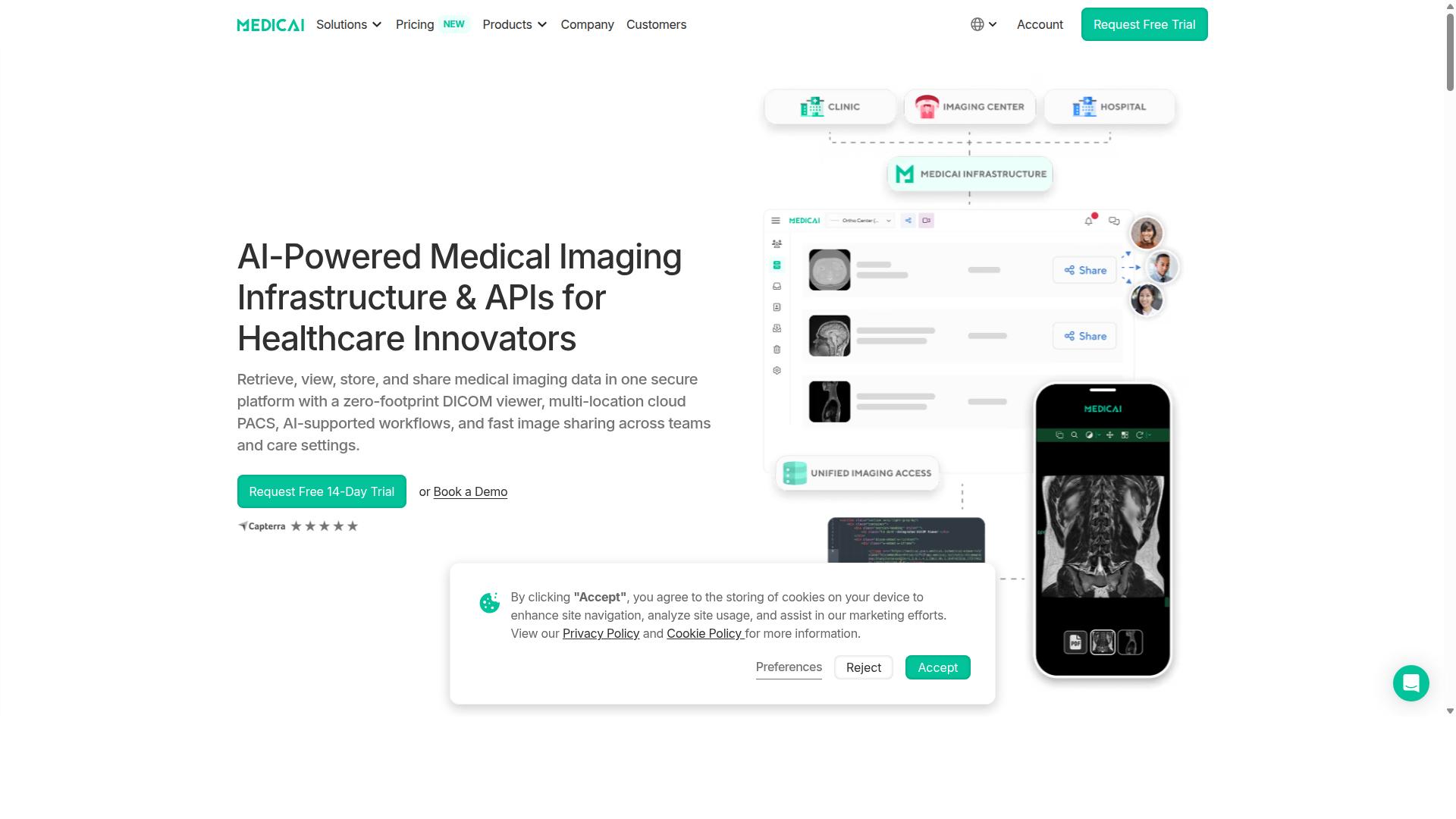
Medicai is a cloud-based medical imaging platform that allows healthcare providers to retrieve, view, store, and share medical imaging data in one secure environment.
The platform serves as Imaging Infrastructure as a Service. It supports medical imaging workflows through a zero-footprint DICOM viewer, medical imaging uploader, DICOM gateway, and cloud PACS.
Healthcare facilities use these components to manage studies across locations. The system provides interoperability between departments and care settings while maintaining data security standards.
A radiology department at a multi-site hospital uses Medicai to access patient studies from different locations. Radiologists open studies directly through the zero-footprint viewer without installing software on local computers, which reduces IT maintenance requirements. For related context, see our guide to MRI Neck With and Without Contrast CPT Code Guide.
The platform includes AI-supported workflows and fast image sharing capabilities. This approach enables radiology teams to collaborate on cases regardless of their physical location.
Medicai focuses on modernizing medical imaging workflows through its cloud architecture. The company operates as a VC-backed healthcare startup dedicated to improving IT infrastructure for medical imaging departments.
Why Is Medicai the Best for IT Infrastructure?
A cloud-native medical imaging platform reduces on-premise hardware needs while meeting strict performance and security requirements. Hospital IT teams often struggle with outdated systems that limit flexibility and increase costs. Moving to modern solutions changes how departments handle daily operations.
Legacy PACS systems create several common challenges. On-premise servers require constant maintenance and frequent upgrades. Storage capacity becomes limited as imaging volumes grow over time.
Network latency affects image access during peak hours. Backup processes often depend on manual schedules that leave gaps in protection. Vendor lock-in prevents migration to better tools when needs change.
Cloud solutions address these issues through several practical improvements. Remote data centers eliminate hardware management tasks for IT staff. Automatic scaling adjusts storage and processing power based on demand.
Redundant backup systems run continuously without human intervention. Data remains accessible from any location with proper authentication. Migration paths exist between different platforms when requirements evolve.
Network architecture benefits from distributed resources spread across multiple regions. Bandwidth optimization reduces transfer times for large DICOM files. Load balancing distributes requests evenly across available servers.
Security measures include encryption for data at rest and in transit. Access control systems track every user interaction through audit logging. Compliance requirements such as HIPAA become easier to maintain with centralized policy enforcement.
Interoperability improves when systems follow standards like HL7 and FHIR. API connectivity allows integration with existing hospital applications. Multi-site deployment becomes straightforward without additional infrastructure investments.
Performance monitoring tools provide real-time visibility into system health. Storage tiering moves older studies to cost-effective locations while keeping recent images readily available. These capabilities support radiology workflow efficiency across the organization.
Key Features and What Makes Medicai Stand Out
Three core capabilities differentiate a modern cloud imaging platform from traditional on-premise systems. These capabilities center on browser-based access, distributed storage with rapid recovery, and API connectivity that supports AI workflows. Together they reduce hardware demands while meeting compliance requirements.
Each of these areas addresses a specific pain point for hospitals and clinics. The first removes local software installation. The second protects data across multiple sites. The third connects imaging studies to third-party analytic tools without extra manual steps.
Organizations that adopt all three features gain a unified infrastructure layer. This layer supports both routine radiology work and specialized tumor board meetings. It also scales with the number of connected locations without new server purchases.
Cloud PACS and Zero-Footprint DICOM Viewer
A zero-footprint viewer lets clinicians open studies instantly in any browser without installing software. The workflow begins with the DICOM Gateway that receives images from local modalities. Those studies are then routed automatically to the cloud PACS according to predefined rules.
Role-based access controls determine who can view or edit each study. Once the data reaches the cloud, the browser renders images through the Medicai Imaging API. No local cache or plugin is required, which simplifies workstation management for IT teams.
Clinics benefit from this architecture because hardware refreshes become less frequent. The same viewer works on tablets during ward rounds and on desktops in reading rooms. As a result, the IT footprint shrinks while study turnaround stays fast.
Multi-Location Storage and Backup
Geographically distributed storage and automated backups ensure continuous access even after local hardware failure. The Standard plan includes 2 TB of cloud storage with the option to expand under Enterprise agreements. A vendor neutral archive layer keeps data format-independent and ready for future migrations.
Encryption at rest protects files while they reside on Microsoft Azure infrastructure. This combination satisfies HIPAA and GDPR requirements without extra third-party tools.
Facilities that connect multiple sites see additional value. Each location can push studies to the same cloud instance, and the single sign-on portal gives specialists across sites immediate access. The setup removes the need for separate on-premise servers at every clinic.
AI-Supported Workflows and API Transactions
API-first design allows third-party AI tools to receive and return imaging data without manual export steps. Medicai processes over 50 million API transactions each year. These calls connect directly to partners such as MD.ai and Rayscape.ai for automated analysis.
HL7 and FHIR feeds populate patient case management modules with structured data. When a new study arrives, the system can trigger an AI job, receive results, and attach them to the correct patient record. This workflow cuts the time radiologists spend moving files between systems.
The same API layer supports internal dashboards that track study volume and turnaround metrics. Hospitals running tumor boards gain a single source of truth for both images and AI annotations. The architecture keeps data movement inside compliant channels rather than relying on USB drives or email attachments.
Pricing and Plans
Two subscription tiers cover different organizational sizes and connectivity needs. Medicai provides clear pricing options that align with varying storage and location requirements for medical imaging infrastructure.
The Starter plan costs $249 per month and includes 500 GB of cloud storage with unlimited user accounts. Organizations with no connected locations can start here when evaluating PACS and DICOM capabilities for their radiology workflow.
The Standard plan costs $749 per month and provides 2 TB of cloud storage with unlimited user accounts plus one connected location. This tier supports healthcare facilities that need direct DICOM gateway integration for their IT infrastructure.
Both plans offer a free 14-day trial of Starter plan features. No credit card is required for the trial period. Yearly billing provides 15 percent savings, bringing Starter to $209 per month and Standard to $639 per month when paid annually.
Enterprise customers receive custom pricing with multiple connected locations supported. A one-time DICOM Gateway Setup fee of $1,000 applies per location. Per-study pricing options are available for organizations with variable imaging volumes.
Refunds are not available for partial billing periods. Organizations should evaluate their storage needs and connectivity requirements before selecting between these two tiers for their medical imaging IT infrastructure.
Trust Signals
Security certifications and measurable usage volumes demonstrate platform reliability.
Healthcare IT infrastructure must handle sensitive data while supporting daily clinical operations. Medicai addresses both needs with documented security measures and proven scale.
Organizations evaluating medical imaging platforms look for concrete proof of stability. Compliance frameworks and transaction volumes together provide that evidence.
Compliance and Security Standards
HIPAA and GDPR compliance plus FDA/CEE clearance are baseline requirements for any medical imaging SaaS.
Medicai meets these standards through a layered control set. OWASP security guidelines shape the underlying code practices.
Usage Metrics and Platform Adoption
Annual transaction counts and storage totals indicate real-world adoption.
Medicai processes over 1M studies per year. Storage capacity holds 1.7M studies with room to grow. The platform delivered 300k DICOM visualizations in the last year.
API usage reached 50M calls per year. 70 clinics and hospitals rely on the system. More than 10,000 doctors actively use the platform for imaging review and collaboration.
These numbers reflect consistent uptime and interoperability. High transaction volume confirms the infrastructure handles peak loads without interruption.
Who Should Use Medicai
Hospitals, imaging centers, and specialty groups that need secure, browser-based access to imaging studies are the primary users.
Multi-hospital systems benefit from HL7 and FHIR integration that connects existing systems without major infrastructure changes. These organizations often operate across different locations and require consistent access to patient imaging data.
Outpatient imaging centers find value in the pay-per-study cost model that scales with actual usage. This approach eliminates large upfront investments while supporting growing patient volumes.
Teleradiology groups rely on the zero-footprint viewer to deliver interpretations from any location. Radiologists can access studies through standard web browsers without installing specialized software.
Healthcare providers across medical specialties use Medicai for their imaging needs. Orthopedics, neurology, oncology, cardiology, and ophthalmology practices all access the same platform for their imaging workflows.
Virtual care providers and telemedicine platforms integrate medical imaging into their patient consultations. Teleradiology services benefit from the browser-based access that supports remote reading workflows.
Personal injury lawyers and tumor boards use the patient portal to review imaging studies. Clinical trials and medical education organizations also access the platform for their specific imaging requirements.
Final Verdict
For organizations evaluating cloud PACS replacements, Medicai offers transparent pricing and measurable scale.
ROI evidence stems from reduced hardware maintenance and predictable subscription costs that replace traditional on-premise infrastructure expenses.
Medical facilities report faster image access across departments, which reduces repeat scans and improves scheduling efficiency.
Scalable storage tiers adjust automatically when imaging volume grows, eliminating the need for manual capacity planning.
Disaster recovery features protect patient data without requiring separate backup systems or extra staff training.
Medicai USA operates from 7901 4th St N, STE 300, St. Petersburg, FL, 33702 with phone support at +1 (832) 220 1035.
Medicai Romania is located at 53-55 N Filipescu, 5th Floor, Sector 2, Bucharest, 020961 and can be reached at +40 316 305 875.
Interested teams may request a live demo through sales@medicai.org to review specific infrastructure requirements and pricing models.