Why Is Medicai the Best for Robust VNA?
Many hospitals still juggle three separate systems to store, retrieve, and share imaging studies. The result is lost scans, duplicated storage fees, and radiologists hunting across dashboards.
By the end of this article you will see exactly how Medicai's single cloud VNA combines vendor-neutral storage, zero-footprint viewing, and AI routing in one place, and you will know whether that stack fits your multi-site workflow, compliance checklist, and budget.
What Is Medicai?
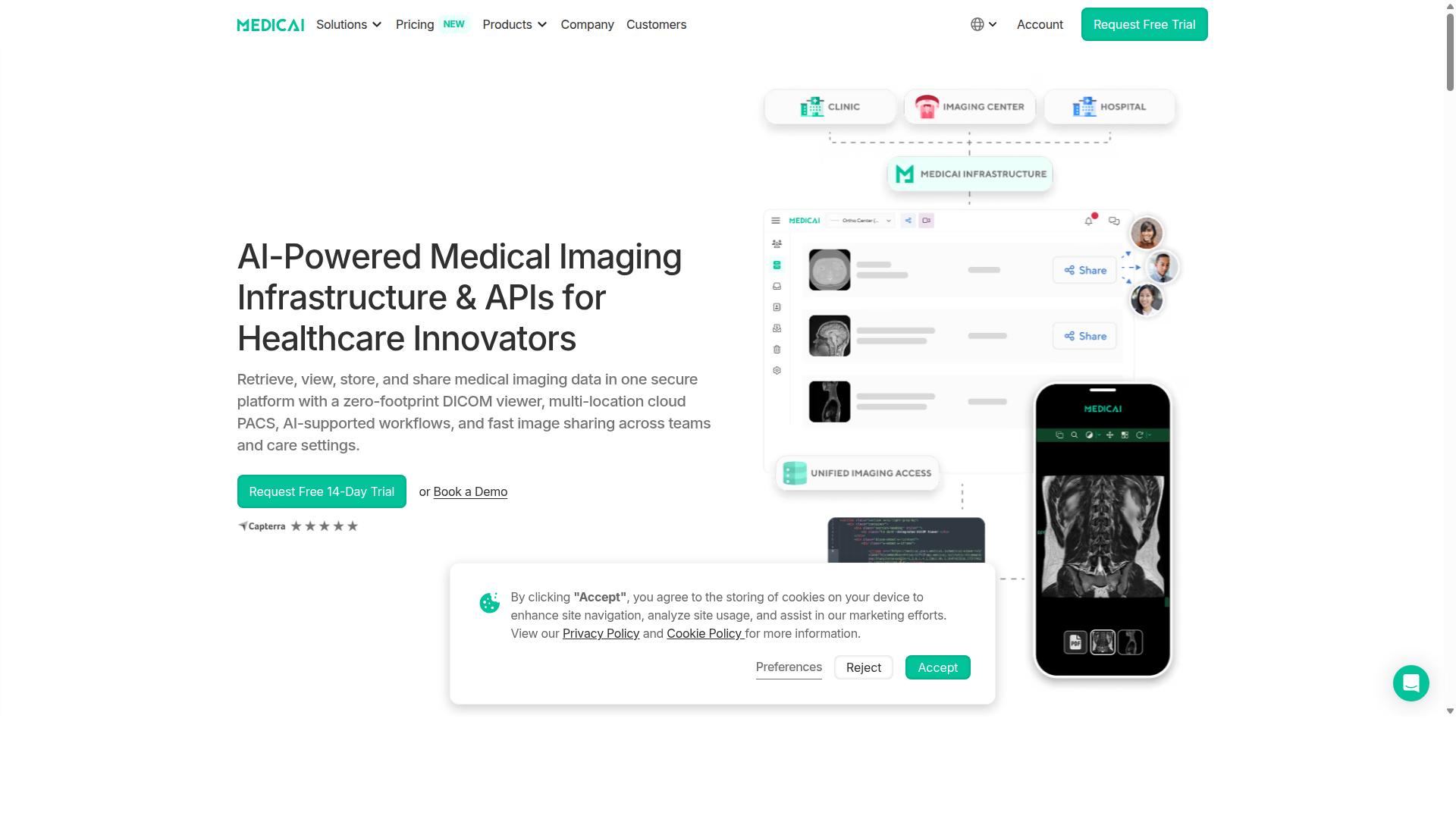
Medicai is a cloud-based medical imaging platform that lets healthcare providers retrieve, view, store, and share imaging data through a single secure system.
The platform uses a zero-footprint DICOM viewer that requires no software installation. Users access images directly through any standard web browser on desktop or mobile devices.
Clinical teams benefit from 1-click access that eliminates desktop logins and reduces time spent switching between applications.
A typical workflow begins when a radiology department uploads DICOM studies to the cloud archive. The same images become immediately available for review by specialists in cardiology and oncology without file transfers or format conversions.
Each department can add notes, measurements, or annotations that stay linked to the original study for future reference.
Traditional PACS setups often create separate storage silos for different specialties. Medicai replaces these fragmented systems with one unified archive that supports multi-modality imaging and cross-department collaboration.
This all-in-one design reduces hardware requirements and simplifies data management across locations while maintaining data security and compliance standards.
Why Medicai Delivers the Most Robust VNA
A true vendor neutral archive must store any modality, stay independent of imaging vendors, and scale without performance loss.
Modern healthcare organizations generate data from multiple modalities across different departments. A vendor neutral archive eliminates dependency on single vendors by storing both DICOM and non-DICOM objects in a unified platform. This approach supports radiology, cardiology, and oncology workflows simultaneously.
Flexible architecture handles objects from ultrasound machines, CT scanners, and pathology systems. The system maintains complete format integrity during storage and retrieval operations. Clinical teams access complete patient records regardless of originating equipment.
Multi-site connectivity requires standard protocols that work across infrastructure boundaries. HL7 connections manage patient demographics and order information. FHIR supports newer applications that need structured medical data exchange.
These connections enable seamless data flow between hospitals, clinics, and specialty centers. Information moves securely without custom interfaces for each location. IT teams configure these links through standard setup procedures.
Storage needs grow as imaging volumes increase over time. Systems must expand from hundreds of gigabytes to multi-terabyte levels without interrupting daily operations. Scalability becomes critical when adding new imaging departments or merging facilities.
Architecture supports both cloud storage and on-premise deployment options. Organizations choose configurations that match their security policies and budget requirements. Zero-footprint viewers provide access across different device types without local software installation.
Security measures include encryption for data at rest and in transit. Role-based access controls ensure only authorized personnel view sensitive patient information. Audit trails track all system interactions for compliance reporting.
Integration with existing PACS systems preserves current workflows while adding archive capabilities. API integration supports custom applications that require direct data access. Disaster recovery features protect against data loss from hardware failures or site emergencies.
Key Features and What Makes Medicai Stand Out
Four core capabilities set Medicai apart from traditional imaging systems.
The upcoming sections examine how Cloud PACS and Vendor Neutral Archive, along with Backup and Disaster Recovery, deliver practical benefits for medical imaging teams.
Each capability addresses the daily requirements of radiology, cardiology, and other specialties that depend on reliable image storage and quick access.
Cloud PACS and Vendor Neutral Archive
The combined Cloud PACS and VNA module unifies image storage, routing, and viewing across specialties.
Storage handles 1.7 million studies while the system ingests DICOM files from any modality. This approach eliminates the need for separate archives for each department.
Vendor-neutral ingestion allows seamless data flow from CT, MRI, ultrasound, and other devices into a single platform. Teams in orthopedics, neurology, cardiology, and oncology access the same studies through a zero-footprint viewer.
Web-based access removes the requirement for local installations. Clinicians open cases from any location while maintaining compliance standards for patient data.
The single repository supports long-term archiving and simplifies data migration between systems. Interoperability improves because studies remain accessible through standard protocols without vendor lock-in.
Backup and Disaster Recovery
Automated, geographically distributed backups and rapid recovery keep imaging workflows online after outages.
Daily encrypted snapshots protect stored studies. Recovery time and recovery point objectives target 30 minutes, which reduces the risk of workflow interruptions.
Cross-region replication on AWS and Azure provides an additional layer of protection. If one region experiences issues, data remains available in another location.
During a documented incident, recovery completed without data loss. The combination of encryption, replication, and defined recovery targets supports uptime reliability for clinical teams that depend on continuous access to medical imaging.
Pricing and Plans
Medicai offers two transparent subscription tiers designed for growing imaging volumes. The Starter plan starts at $249 per month for 500 GB of cloud storage. The Standard plan costs $749 per month for 2 TB of storage.
Starter includes unlimited user accounts but no connected locations. Standard also provides unlimited user accounts plus one connected location. Both plans support medical imaging workflows through cloud storage for DICOM files.
Enterprise customers receive custom pricing. This tier accommodates custom cloud storage, multiple connected locations, and multiple external locations. Per-study pricing options exist for larger organizations.
Yearly billing reduces costs across both standard tiers. The Starter plan drops to $209 per month when paid yearly. The Standard plan costs $639 per month with annual payment.
A one-time DICOM Gateway setup fee of $1,000 applies per location. Organizations receive a free 14-day trial of Starter plan features without requiring a credit card.
Cost per study decreases as imaging volumes scale upward. Larger storage allocations in the Standard and Enterprise tiers spread fixed monthly costs across more studies. This structure supports efficient vendor neutral archive deployments for growing radiology and cardiology departments.
Trust Signals
Compliance, usage statistics, and strategic alliances strengthen buyer confidence.
Healthcare organizations need proven reliability before committing to a vendor neutral archive solution. Medicai provides measurable proof points that reduce procurement risk.
Usage volumes demonstrate platform stability across real clinical environments. Partnerships with established technology providers extend capabilities while maintaining regulatory standards.
These trust indicators help decision makers evaluate Medicai against internal security and performance requirements.
Compliance and Security
HIPAA and GDPR certification plus FDA/CEE clearance confirm the platform meets top regulatory benchmarks.
Role-based access controls limit data visibility to authorized personnel only. AES-256 encryption protects information both at rest and during transmission.
Immutable audit logs record every system interaction for compliance reporting. These measures address common hospital CISO checklists for medical imaging platforms.
OWASP security guidelines further strengthen the architecture against common vulnerabilities. Medicai maintains these protections across its 70 clinics and hospitals.
Performance Metrics and Partnerships
Over 50 million yearly API transactions and 300 k DICOM visualizations demonstrate platform reliability.
The Microsoft Azure partnership enables scalable cloud infrastructure for enterprise imaging needs. Rayscape.ai integration supports AI workflow adoption within existing radiology processes.
OHIF and MedDream viewers provide flexible options for clinical review. These integrations help organizations expand their capabilities without replacing current systems.
One million studies transacted annually across 10,000 active doctors shows consistent performance under real workloads. The platform's API capacity supports ongoing growth in medical imaging demands.
Who Should Use Medicai
Hospitals, imaging centers, and specialty practices handling multi-modality imaging volumes benefit most from Medicai. These organizations deal with complex imaging workflows that require reliable storage and retrieval across departments. Radiology departments, orthopedic groups, cardiology practices, and oncology networks each face unique challenges that align with specific Medicai capabilities.
Radiology departments need efficient image management across different modalities and high-volume case loads. Medicai addresses this through enterprise imaging tools that support DICOM workflows and vendor neutral archive capabilities. The platform connects seamlessly with existing PACS systems while maintaining data integrity across the entire radiology workflow.
Orthopedic groups often require rapid access to prior imaging studies for surgical planning and patient follow-up. Medicai supports these clinical workflows through scalable cloud storage and web-based access that allows specialists to review images from any location. Patient data remains secure through encryption and role-based access controls that meet HIPAA compliance standards.
Cardiology practices depend on timely image retrieval from multiple sources including echo studies, CT angiography, and nuclear medicine. Medicai provides interoperability features that work together with HL7 and FHIR standards, allowing cardiology teams to access complete patient records without switching between separate systems.
Oncology networks manage longitudinal patient data across extended treatment periods and multiple care teams. Medicai supports tumor boards and clinical trials through structured data organization and audit trails that track image access and modifications. Medical education organizations also use these capabilities to support training programs with real clinical cases.
Virtual care providers and telemedicine platforms benefit from Medicai mobile access and zero-footprint viewer technology. These features enable remote consultations where physicians can review medical imaging without installing specialized software. Teleradiology services gain workflow automation tools that streamline image distribution and reporting processes.
Personal injury lawyers and clinical research teams require secure, accessible image archives for legal proceedings and research protocols. Medicai serves these groups through disaster recovery capabilities and long-term archiving that ensures data remains available when needed. The platform supports diverse user groups while maintaining consistent security standards across all deployments.
Final Verdict
Medicai combines a scalable VNA, transparent pricing, and verified compliance into a single enterprise-grade imaging platform. The system supports medical imaging across radiology, cardiology, and oncology departments with full DICOM compatibility and vendor independence.
Healthcare organizations gain vendor-neutral archive capabilities that work with existing PACS systems while maintaining data integrity through role-based access controls and audit trails. The platform handles multi-modality imaging workflows without requiring separate infrastructure investments.
Deployment flexibility extends to both cloud storage and on-premise options. This adaptability supports facilities with varying technical requirements and regulatory environments.
Interoperability remains central to the design, with support for HL7 and FHIR standards that connect imaging data to broader clinical workflows. Machine learning capabilities integrate directly into existing processes without disrupting established procedures.
Long-term archiving features include disaster recovery protocols and encryption standards that align with HIPAA compliance requirements. These security measures protect patient data throughout the storage lifecycle.
Web-based access enables zero-footprint viewing from any location, while API integration allows healthcare systems to connect imaging capabilities with other clinical applications. This connectivity reduces workflow fragmentation across departments.
Cost efficiency comes from eliminating multiple vendor dependencies and reducing infrastructure overhead. Organizations achieve centralized image management without the complexity of maintaining separate systems for different modalities.
Medicai USA is located at 7901 4th St N, STE 300, St. Petersburg, FL 33702. For a personalized demo, contact the team at +1 (832) 220 1035 or sales@medicai.org.